June 17, 2025
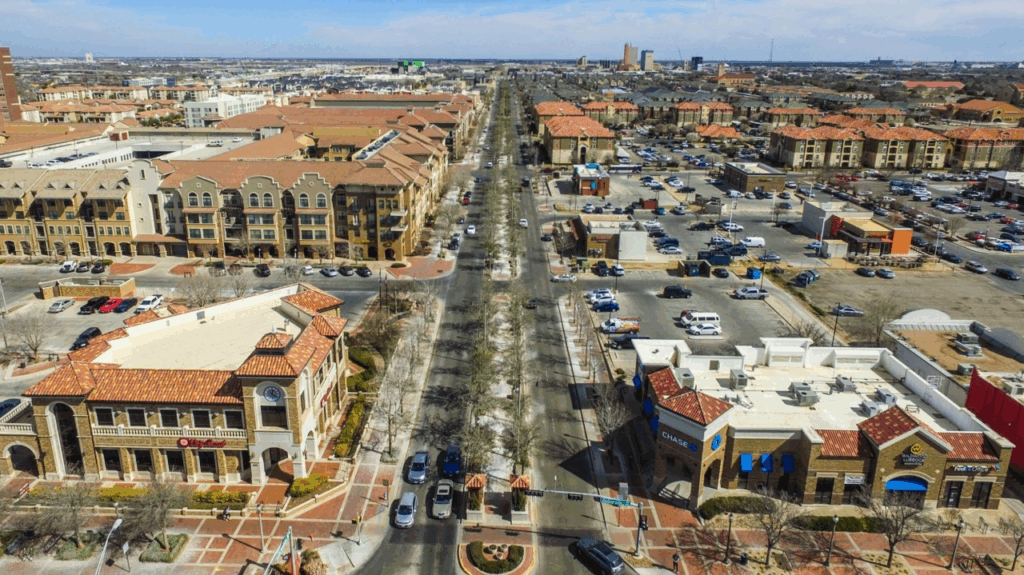
Drive through Overton Park today in Lubbock, Texas, and you’ll see retail, restaurants, walkable housing, and students heading to class at Texas Tech University . It feels intentional, like a small urban village that just works.
But rewind to the early 2000s, and Overton was one of the highest-crime areas in Lubbock. It was fragmented, neglected, and slowly hollowing out. What changed?
McDougal Companies launched what became the largest privately funded urban renewal project in the country. They assembled more than 300 parcels of land, demolished blighted homes, rebuilt roads and public infrastructure, added green space, and master-planned a thriving, mixed-use community. It wasn’t just real estate development. It was a full reset of what a neighborhood could become.
One of the most remarkable parts? They did it without using eminent domain.
No forced takings. No mass displacement. No legal battles in the press. Just block-by-block trust-building with willing sellers, a clear long-term vision, and patient private capital willing to bet on the future of Lubbock.
Naturally, this leads to a big question for those of us in St. Louis:
Could something like Overton happen here?
The honest answer? Maybe. But only if we learn from our past.
Because we’ve tried bold redevelopment here before.
In 2009, developer Paul McKee introduced the $8 billion “NorthSide Regeneration” plan—a massive, top-down vision to revitalize 1,500 acres in North St. Louis. Backed by public incentives, the plan promised jobs, infrastructure, and investment.
What actually happened? Missed deadlines. Vacant properties. Community skepticism. And eventually, in 2019, a formal “bad actor” designation from the city. Eminent domain was authorized to reclaim decaying parcels. What began with fanfare ended in frustration.
So what went wrong?
- Top-down planning without community voice
- Over-reliance on tax incentives that rewarded speculation
- No accountability when timelines slipped
- Neglect of resident-led progress already underway
If St. Louis wants an Overton-style success, it needs more than capital and more than ideas. It needs alignment.
Alignment between residents, developers, and government.
Alignment between risk and stewardship.
Alignment between ambition and accountability.
It’s possible. But it requires a new approach. Here are three keys:
1. Take the Long View
No major transformation happens in a two- or three-year window. If we want to meaningfully rebuild a community, it will take a five-year plan that rolls into a 10- and 15-year roadmap. It requires the kind of patience and persistence that most developers and public agencies aren’t typically incentivized to hold.
Urban redevelopment is about more than buildings. It’s about where people live, work, and grow. We’re not just dealing with housing stock, we’re dealing with trauma, disinvestment, and decades of systemic neglect.
We have to acknowledge how hard this is. Crime, poverty, poor schools, health disparities—none of these challenges have easy fixes. But none of them are impossible either. We just have to commit to progress over perfection and make patient, compounding improvements over time.
2. Residents Come First
This is the cornerstone. Not optional. Not a check-the-box step. Residents must lead.
In Overton, McDougal succeeded in part because they respected the human side of the work. They built trust, block by block. In St. Louis, any successful redevelopment effort must be rooted in the lived experiences, desires, and leadership of residents.
Too often in St. Louis, we’ve seen projects built for communities, not with them. That has to change. We need co-creation, not just consultation. We need forums that actually share decision-making power.
And we need to make these areas so safe, livable, and economically viable that people choose to stay and others choose to move in. This isn’t about gentrification. It’s about creating places people are proud to call home.
If redevelopment doesn’t make life better, safer, and more fulfilling for current residents, what’s the point?
3. Start with Employment
Want to change a neighborhood? Start by creating jobs. Real, meaningful, purpose-driven work.
You can’t rebuild a place if 20% of young men are disconnected from the labor force. Employment brings structure, dignity, and connection. And work can take many forms: paid jobs, apprenticeships, community service, and local business ownership.
And today, work doesn’t have to mean retail or low-wage service jobs because here’s where it gets exciting:
With AI tools and training, we could retrain anyone who can read into an entry-level AI data analyst. We have the tools. We just need the will—and the infrastructure to scale it.
I want to live in a world where North St. Louis is a destination for the area, not a place to avoid.
So Where Do We Go From Here?
Let’s be honest: this all sounds hard. And some might even say it’s naive.
But we’ve seen it work. In Lubbock. And other cities in US and even across the world. These places aren’t perfect. But they’ve moved the needle.
If we want to do the same in St. Louis, we need to stop thinking in election cycles or developer timelines. We need:
- A 15-year vision with flexible milestones
- A coalition of residents, businesses, and civic leaders
- A strong employment engine to drive economic inclusion
- Trust-based land acquisition
- And above all, humility and listening
This isn’t a call for utopia. It’s a call for one square mile of focused progress. Start small. Build trust. Scale what works.
Block by block. Job by job. Day by day.
We can do this.
But only if we do it together.
So what do you think?
Could an Overton-style reinvention work in North St. Louis? Could we build the right team, the right plan, and the right momentum?
Or are we still stuck with the same old playbook?
I’d love to hear your thoughts